
Labour force, survey
13. Mar 2026
Lowest unemployment in Europe
The annual labour force survey is conducted according to international standards in line with the guidelines of the International Labour Organization (ILO) under the United Nations. This makes Faroese statistics comparable with those of other countries, for example with statistics from Eurostat, the statistical office of the European Union.
Unemployed persons are part of the available labour force. According to the ILO definition, unemployed persons are those who during the reference period had no work, were actively seeking work, and were available to take up work within two weeks. The unemployed therefore include both those who are registered as unemployed in unemployment schemes and those who are not registered in any unemployment scheme. Unemployment, or the unemployment rate, is the share of the labour force that is unemployed.
The unemployment measured in the survey is not comparable with the unemployment statistics published monthly, which are based solely on registers from unemployment schemes.
Internationally comparable unemployment covers the age group 15 to 74 years. The monthly unemployment statistics, which are based only on registers, cover the age range 16 to 66 years.
Low for both women and men
Unemployment in the Faroe Islands has been steadily declining since 2022 and now stands at 1%.
Unemployment has fallen for both sexes. It is slightly lower for women, at 0.9%, while for men it is 1.2%.
[px-graph-1]
Lowest unemployment in Europe
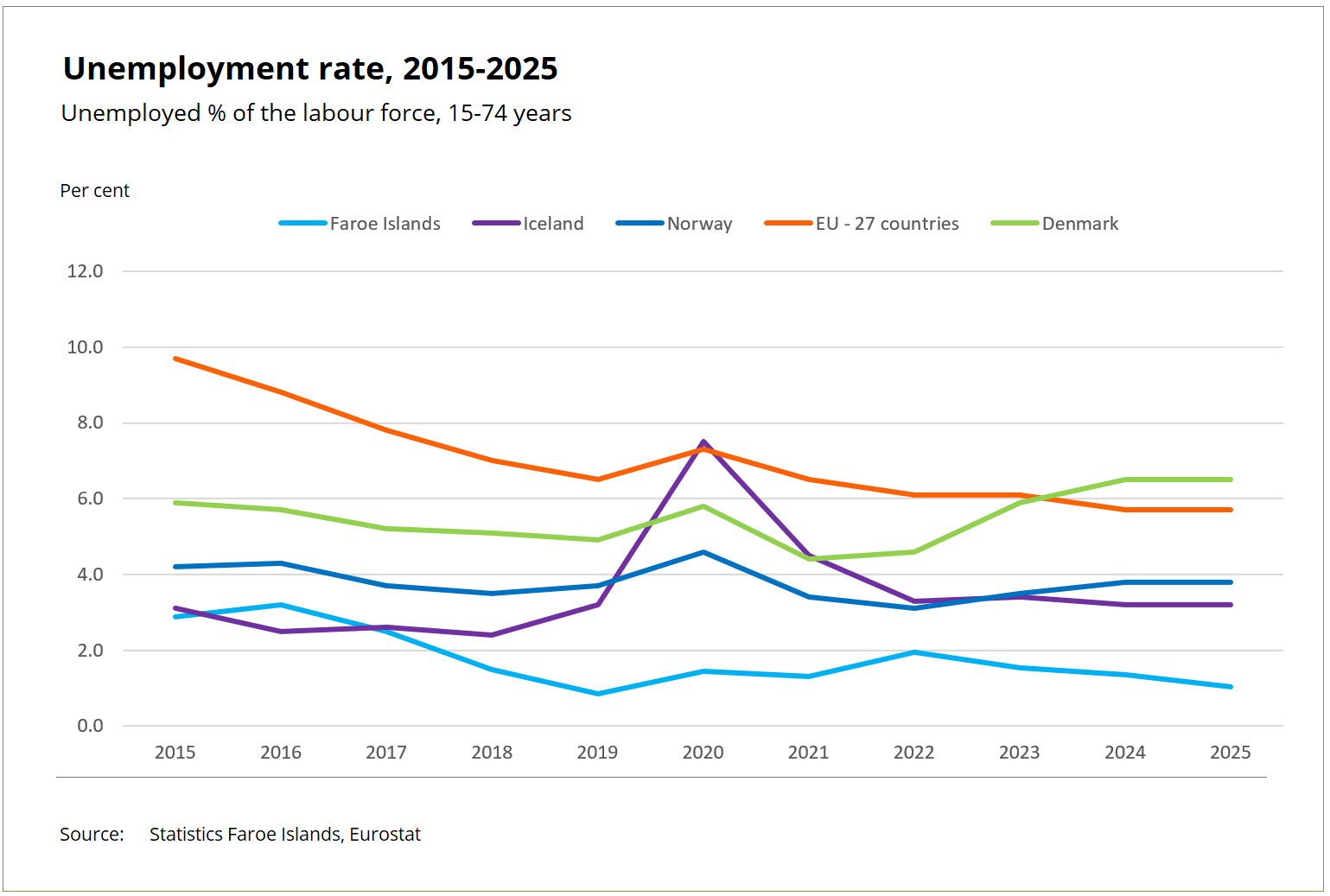
The Faroe Islands have a proportionally low unemployment rate compared with other countries. Among the Nordic countries shown and the EU average in the years 2015 to 2025, the Faroe Islands have the lowest unemployment. Iceland is the only one of these countries that, in one year only, 2016, had lower unemployment. In 2020, when the COVID-19 pandemic struck, an increase in unemployment can be seen in all countries.
The Eurostat figures are available here.
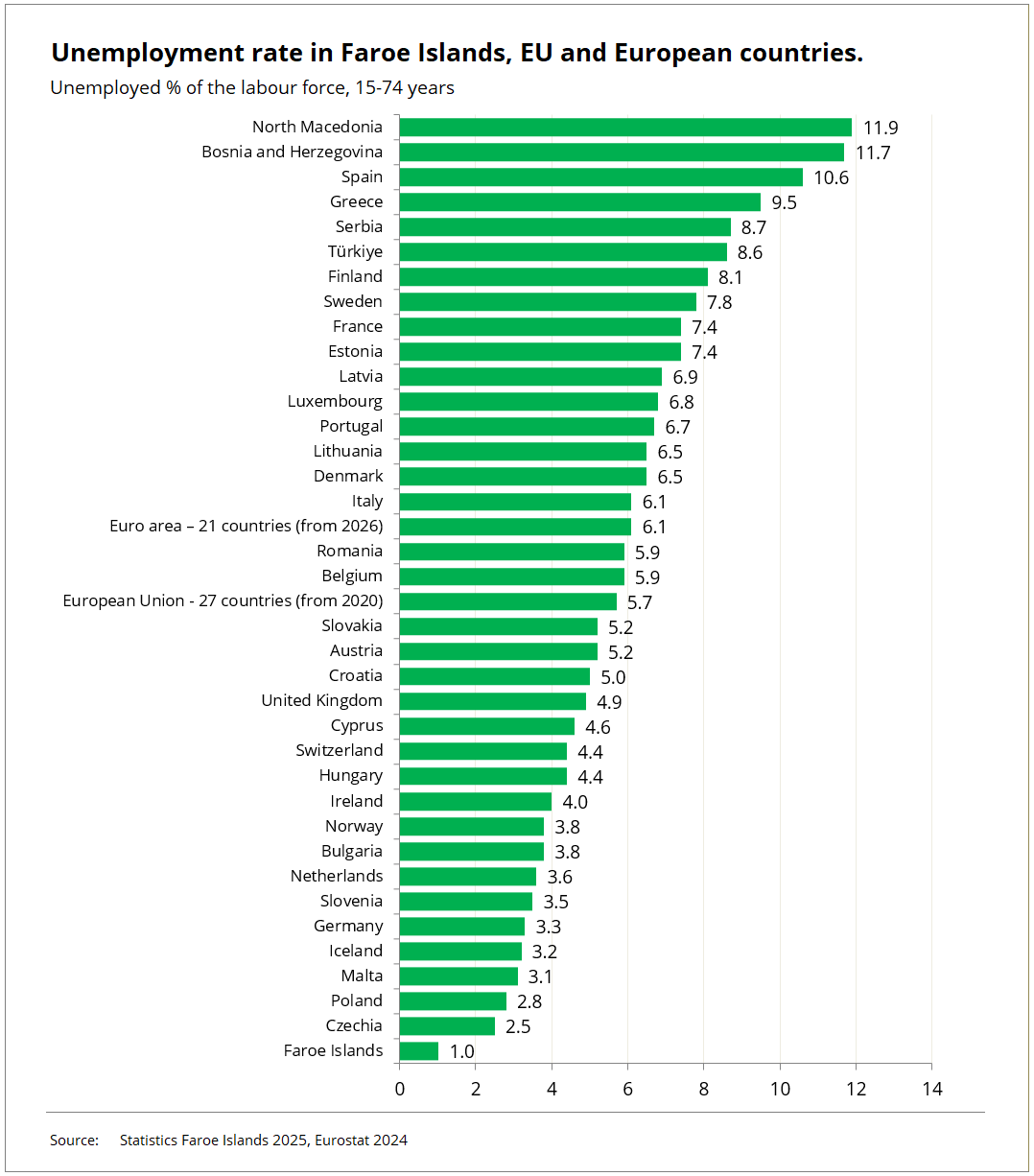
The Faroese figures are from the fourth quarter of 2025. Eurostat has not yet compiled labour force figures for this period. The fourth quarter of 2024 is therefore used for comparison. The reason for using the fourth quarter of 2024, rather than newer European statistics, such as the third quarter of 2025, is that they are more comparable due to seasonal changes in the labour force in the countries. Ages 15 to 74 are the internationally comparable age range used.
In Europe, the Faroe Islands have the proportionally lowest unemployment, at 1%. The highest unemployment is in North Macedonia, where it is 12%. Denmark, Sweden and Finland are all above the EU average, while the other Nordic countries are below it. Czechia is the country closest to the Faroese unemployment rate, at 2.5%.
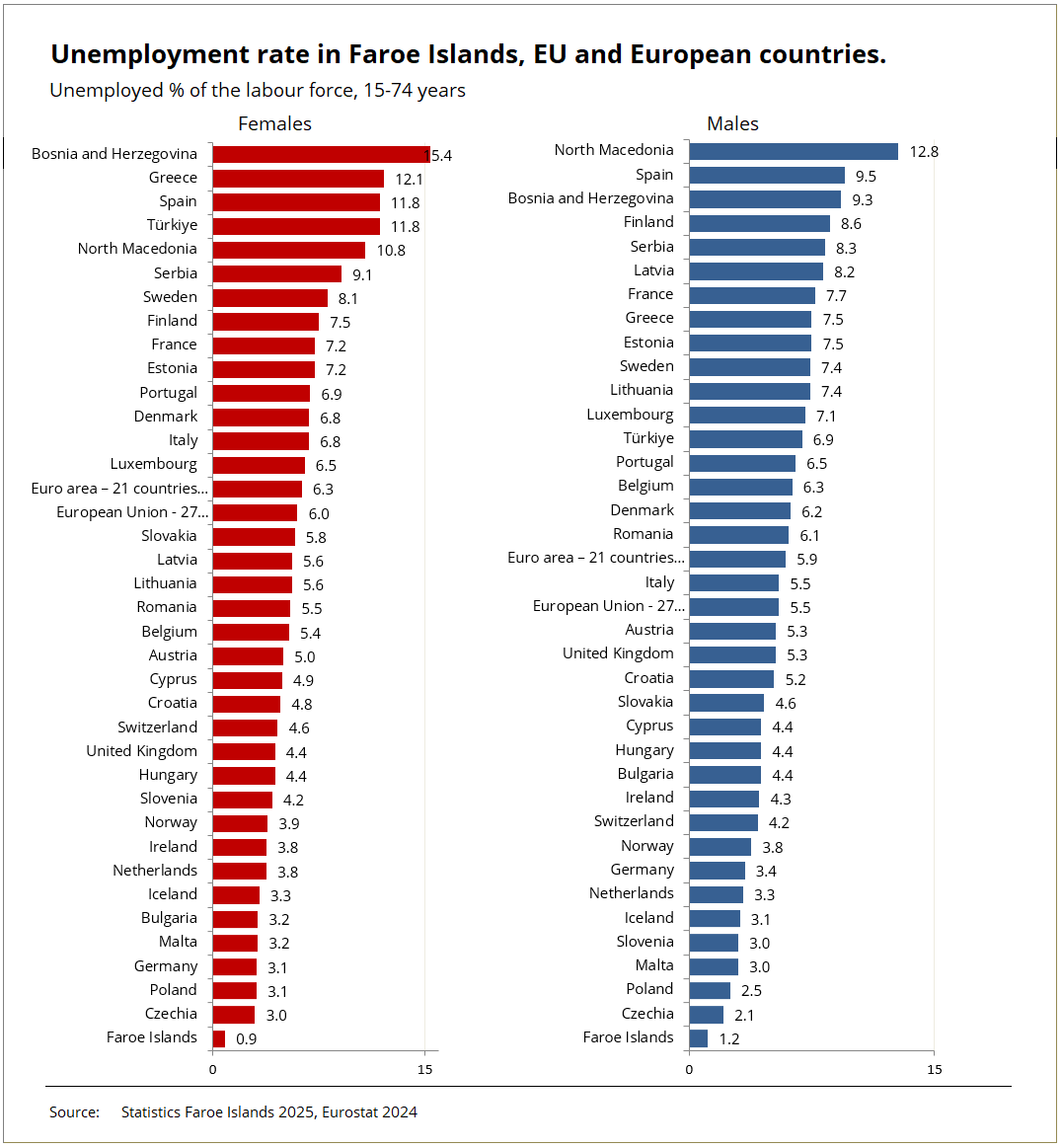
Both Faroese women and men are the lowest among the countries shown in Europe. Unemployment among Faroese women stands out in particular, at 2.1 percentage points lower than the next country, which is Czechia at 3%. Unemployment among Faroese men is 0.9 percentage points lower than the next country, which is also Czechia.
Highest unemployment among young people
Unemployment in the Faroe Islands is considerably lower in all age groups when compared with Denmark and the EU. The highest unemployment is among young people aged 15 to 19. In the Faroe Islands, the second-highest age group is 25 to 29 years, whereas in the others it is 20 to 24 years.
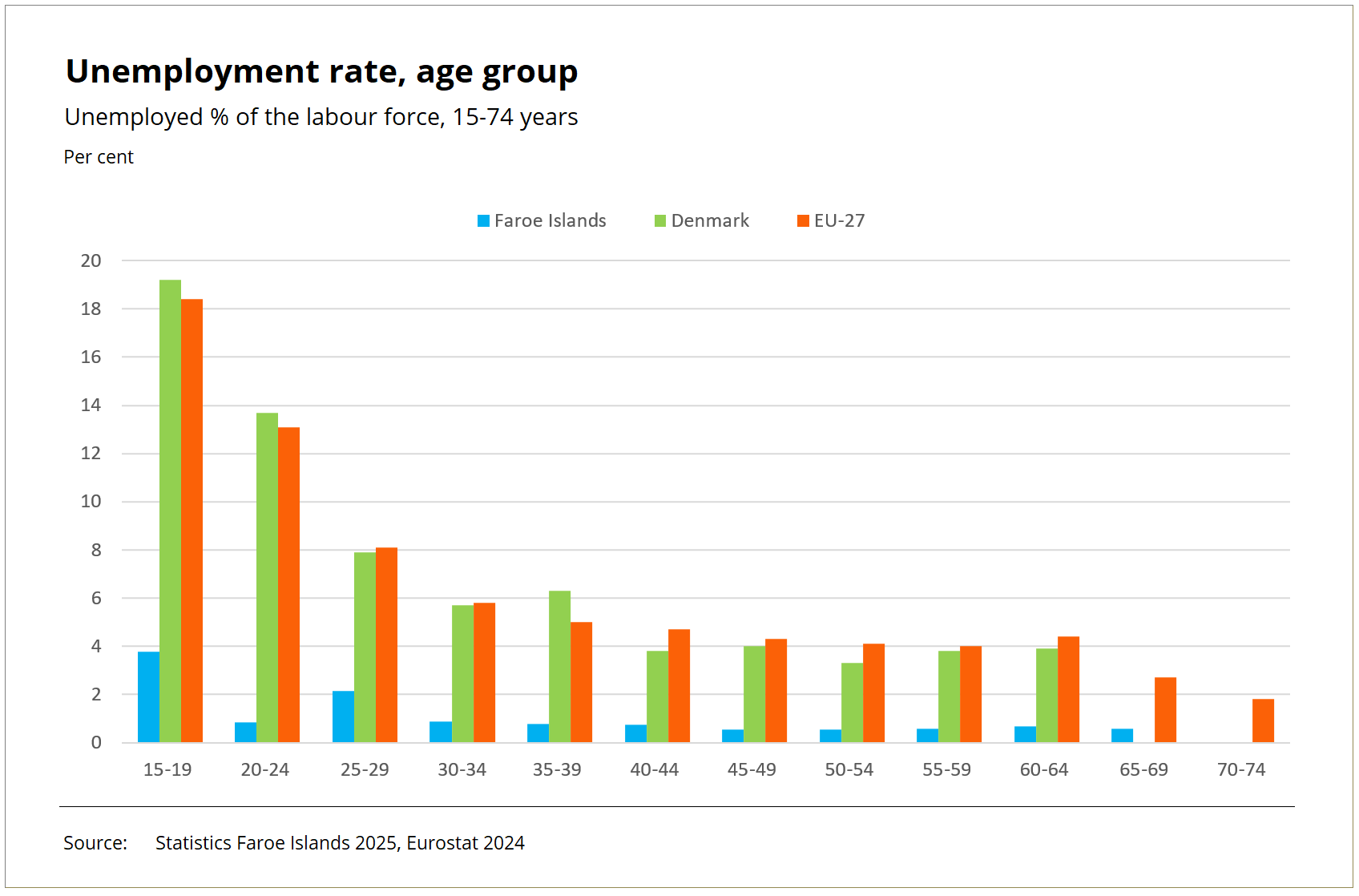
Eurostat’s comparable charts by age groups are available here.
About the labour force survey
The annual labour force survey is conducted according to international standards and in accordance with the guidelines of the International Labour Organization (ILO) under the United Nations (UN). This makes the Faroese figures comparable with those of other countries, for example in Eurostat’s statistical database. The international standard stipulates that the survey must cover all persons resident in the country aged 15 to 74. The survey is conducted at the end of November each year and determines labour force status for the week that includes 15 November.
The statistical purpose of the survey is to classify persons according to whether they were active during a short reference period. Most persons are classified as employed or unemployed on the basis of a full count derived from administrative registers. Around 9,500 persons remain who cannot be classified. Of these, 1,300 persons are randomly selected to answer a questionnaire. Based on the results of the survey and other statistical sources, the remaining persons are then classified.
New methodology for compiling labour force statistics
A new methodology has been developed to produce a more accurate estimate of the Faroese labour force. The labour force has been revised back to 2015 using this new method. The compilation of the labour force will, as before, be based to a large extent on registers and on a survey covering the part of the population that cannot be classified from registers.
Previously, this latter part of the population, which is compiled using the survey, was grossed up by age, sex and area of residence. Since Statistics Faroe Islands now has more and better structured information, it is possible to create a better model for this part of the population. The model is based on many more variables than the three mentioned above. The new model analyses responses on labour market status from the survey on the basis of, among other things, income (including wages and benefits), household composition, education, residential attachment, student status, marital status, age, sex and area of residence. The variables that prove each year to be best at analysing responses on labour market status are used to compile this part of the population.
Changes in the statistics
The revision based on the new methodology means that the labour force statistics have changed somewhat. In particular, the labour force has decreased slightly, while the number outside the labour force has increased. See the difference between the old and the new labour force estimates below.
Statistics prior to 2015 are not based on registers, but entirely on survey data. For that reason, the figures for those years have not been revised.
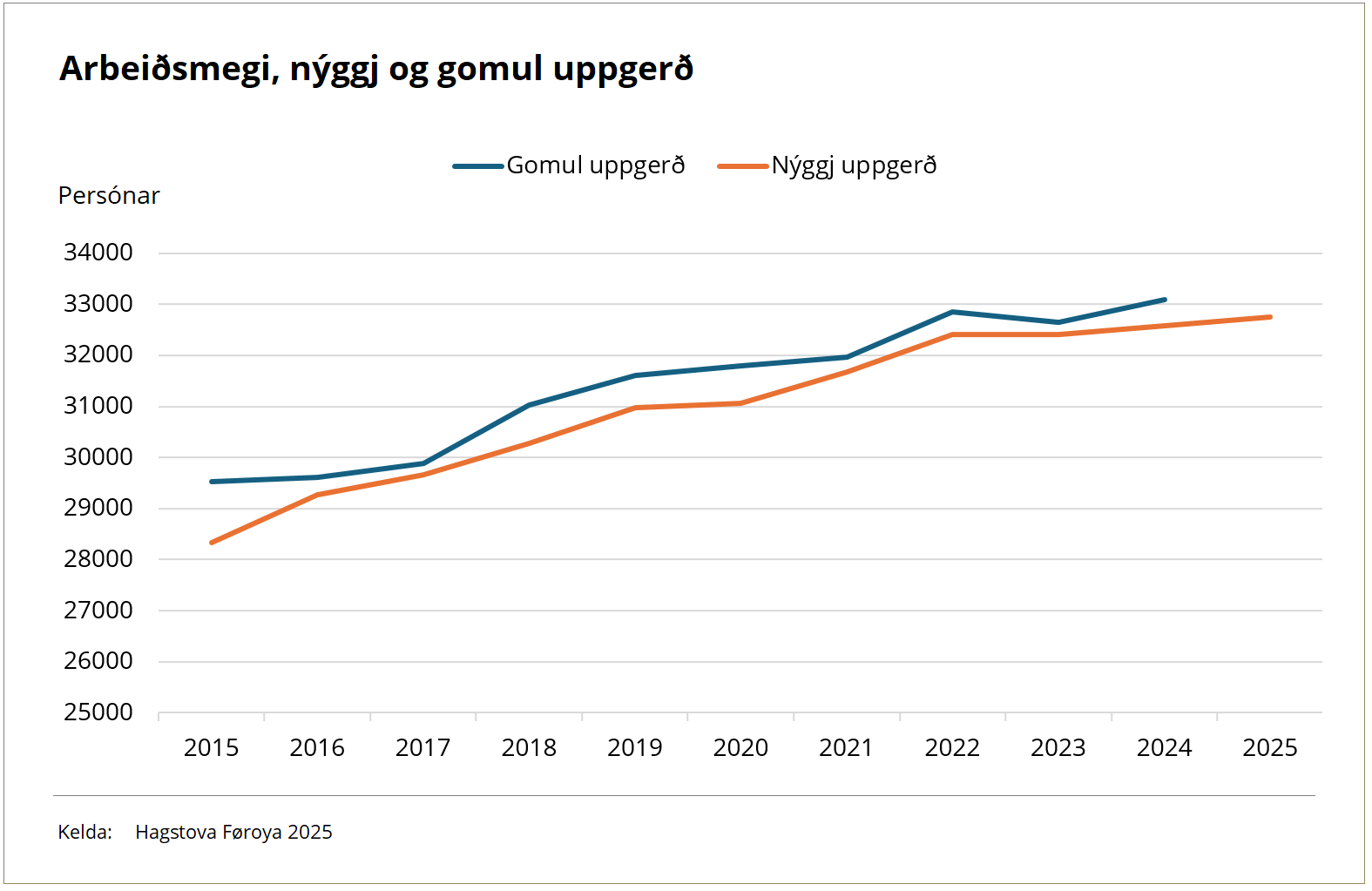
Definitions
- The labour force consists of people who are able to supply labour. This includes the employed and the unemployed.
- Employed people are defined as those who during the reference period worked for minimum one hour for wage or salary, or profit or family gain, in cash or in kind. Persons temporarily not at work also count as employed, if they have a formal attachment to their job.
- Unemployed people are defined as those who in the reference period were without a job, actively seeking work and fully available to the job market within two weeks.
- Outside the labour force are individuals who during the reference period were not part of the labour force, meaning they were neither employed nor unemployed. This set of people are also called the ‘inactive population’.
- Population is the total number of people in working age (ie. 15 to 74 years)
- Activity rate is the labour force in % of the population in working age (ie. 15 to 74 years)
- Employment rate is employed in % of the population in working age (ie. 15 to 74 years)
- Unemployment rate is unemployed in % of the labour force
- EA refers to the euro area with a fixed area composition of the current 20 countries (2023).
- EU is the European Union with a fixed area composition of the current 27 countries (2020).